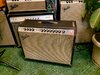
The Twin from hell

Steverino

NO VACANCY
It’s a beater, found by a friend “American Pickers” style in his garage. ‘79-80 MV with the pull-out boost knob, 135W Ultra Linear.
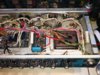
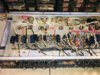
No cab/speaker. Beaten and abandoned, no tubes, mostly untouched under the hood except for one replacement cap in the tremolo circuit. All original filter caps. Two 6L6 sockets saw some harsh action at some time, they most certainly red-plated. Power trans is good, Output trans appears to be ok but I’m suspicious, more testing. It’s not regarded as the greatest Twin by most.
It’s a freebie.

What would you do with it? Landfill?

It’s a hobby/project so I'm not out to make a profit and sell it or break the bank, but am willing to spend what it needs to bring it back to full operation (barring having to replace a transformer). I have a lot of parts on hand already, sans the cab and speakers.

It’s 40 pounds!
 

Attachments

  • 570DA256-F6D6-4F1C-807E-48284349F174.jpeg
    570DA256-F6D6-4F1C-807E-48284349F174.jpeg
    3.7 MB · Views: 344
  • 84D6D561-CCF3-4547-BF7D-A754E8CF7EE7.jpeg
    84D6D561-CCF3-4547-BF7D-A754E8CF7EE7.jpeg
    3.4 MB · Views: 319
  • F4E2EC9B-3361-4E05-B5FF-1B82D853DDF6.jpeg
    F4E2EC9B-3361-4E05-B5FF-1B82D853DDF6.jpeg
    2.5 MB · Views: 328
Probably loud as fuck. Not a well regarded circuit. I don’t know how far it is from the earlier circuits that sound better, you might be able to modify it back to blackface specs.
 
The reverb tank. I forgot to mention it's also gone.

I'm under no time constraints to finish it, so I can take my time in looking for parts. What I'd like to do is to find a cab for it, beaten and weathered, nothing new or restored, and slide that chassis in. JBLs would be the way to go I think, and they'll probably be the most expensive part of this project.
 
Just an update, working on it in my spare time.

When you get a amp like this (no cab, no tubes, not much of a backstory) you sometimes feel like a forensic scientist, trying to figure out what the hell happened. The guy who gave it to me said when he powered it up, he saw smoke and one of the transformers got hot (not sure which one), so I've got that to go on.

I plugged it into a Variac, dim-bulb tester (no tubes inserted) and an iso trans and brought it up slowly, trying to reform the filter caps and just to see if there were any internal shorts in the power transformer. It's okay, there's almost 500VDC at the OT center tap primary! What a beast. Next, onto the output transformer. I found no shorts or opens with an ohmmeter, all the measurements are nominal.

Of the four output tube sockets, each should have two resistors soldered across its pin connections, a 1500Ω ohm grid stopper and 470Ω ohm 1W screen resistor. One tube socket had a burnt (in two) grid stopper, and on another, the 470Ω resister was gone. What the..? You could see the holes in the solder joints where its leads were. Did it explode? I have no clue, but I do suspect this; there's either a shorted cap upstream or one or more of the output tubes were shorted internally, causing a massive current draw. I'll check those coupling caps next. If they're okay, I'll move on.

I've replaced all 8 of the resistors on the output tube sockets. Next is to slowly power it up with tubes inserted, again on a Variac and dim bulb tester. If there's no massive short or current draw, I'll inject a signal and listen for anything out of a speaker.
 
One thing I would do now is replace the electrolytic cap in the bias circuit, it this fails, it can burn out tubes and/or the power transformer.

Ultimately, these are big, clean, stiff amps because of their high plate voltages, pedal steel guitar players love them, many others may find them a big sterile. But they can be made into great pedal platforms. Some ideas once you confirmed it's worth sinking some cash into ...
  • I would go through and replace all the electrolytic caps
  • I would probably replace all plate resistors, it looks like they wisely moved up to 1-watt plate resistors by that time but, like the grid and screen resistors, these tend to bake over time. A goo 1-2 watt carbon film will be more reliable.
  • I would disconnect the negative feedback loop, this makes a noticeable difference in warming the amp up. The UL circuit and NFB loop compounded each other, like a belt or suspenders...you only need one
  • Some people disconnect the screen taps and use a more traditional OT setup on these, but the UL winding ratio is pretty conservative on these, and I don't think it's a bad thing to leave it
That's some weird wear and tear on the faceplate, all the marks at the jacks could just be poor aim (the input jacks don't look original), but around the pilot light?
 
One thing I would do now is replace the electrolytic cap in the bias circuit, it this fails, it can burn out tubes and/or the power transformer.

Ultimately, these are big, clean, stiff amps because of their high plate voltages, pedal steel guitar players love them, many others may find them a big sterile. But they can be made into great pedal platforms. Some ideas once you confirmed it's worth sinking some cash into ...
  • I would go through and replace all the electrolytic caps
  • I would probably replace all plate resistors, it looks like they wisely moved up to 1-watt plate resistors by that time but, like the grid and screen resistors, these tend to bake over time. A goo 1-2 watt carbon film will be more reliable.
  • I would disconnect the negative feedback loop, this makes a noticeable difference in warming the amp up. The UL circuit and NFB loop compounded each other, like a belt or suspenders...you only need one
  • Some people disconnect the screen taps and use a more traditional OT setup on these, but the UL winding ratio is pretty conservative on these, and I don't think it's a bad thing to leave it
That's some weird wear and tear on the faceplate, all the marks at the jacks could just be poor aim (the input jacks don't look original), but around the pilot light?

Hey Wyatt, I was hoping you'd drop by. I do intend to replace all electrolytics. The caps in the doghouse are original. All plate resistors have been replaced with 1W resistors. I didn't have carbon film, though. I can still replace them with better resistors though. I'll look into that feedback loop, sounds like a good idea.

I have seen some "mods" that did indeed delete the ultralinear screen taps. I was wondering why anyone would do this, other than trying to take the circuit back to earlier Twin specs. I don't plan on doing this.

Right now, I'm mostly concerned with simply getting it in working order. Although the OT checks out with an ohmmeter, I'm still not convinced it's okay. Looking at the output tube sockets and burnt resistors, it's apparent the OT took some serious punishment. If it's toast, I've got a boat anchor.

The weird scars on the faceplate are a mystery. I'm thinking this thing has been out of it's long-gone cabinet for a loong time, being banged around from one junk heap to another.
 
i dunno, that thing looks like it went thru a flood.

I does look pretty rough. I'm pretty sure it didn't go under water, most definitely didn't see salt water, though you know how humid it is down here, year 'round. :) The eyelet boards on these can and will conduct if they get damp enough.

You can (if you really wanted to) literally hose these things down, run 'em through the dishwasher etc. I've seen older tube gear (ham radios) taken outside and pressure washed. Some of the old Collins radios were specifically built to take the elements.
 
I does look pretty rough. I'm pretty sure it didn't go under water, most definitely didn't see salt water, though you know how humid it is down here, year 'round. :) The eyelet boards on these can and will conduct if they get damp enough.
You can (if you really wanted to) literally hose these things down, run 'em through the dishwasher etc. I've seen older tube gear (ham radios) taken outside and pressure washed. Some of the old Collins radios were specifically built to take the elements.
if you get it working well, you'll have one of the best clean tube sounds on the planet. :idea:
 
Almost 3 years ago. Well I didn't intend taking this long, but here we are! I finally got back to this project about a month ago. Just before that, I had rebuilt a late-70s Pioneer SX-1080 that was so bad I considered parting it out. Glad I didn't.
3.jpg
I gave this one away to my brother-in-law. I can't believe what they're going for in refurbished condition these days.

So, the Twin:
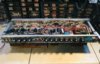
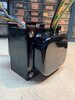
After a good deal of cleaning, (some painting), pots, switches, replaced all electrolytics of course, out of tolerance carbon comp resistors, some burnt components, re-flowing solder joints. Rechecked the transformers, they were rusty, nasty hulks of iron, so I cleaned 'em up. After what this thing had been through, you had to look at everything. Replaced all four output sockets, they saw a lot of heat in some previous meltdown. Some wiring had to be replaced. I finally got to the day I was ready to power it up for the first time.

output trans1.jpgpost2.jpgpower trans1.jpgpower trans2.jpg

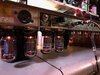
I slowly brought it up with a Variac and a dim-bulb tester in line. In checking voltages before putting tubes in, I think I discovered why it melted down in the first place; the bias diode was cracked. I couldn't see it, but when I put a test lead on it (and saw no negative VDC) it broke. No wonder it red-plated, probably all four of them. Made that repair quickly with a 1N4007 and everything was fine after that. Went and grabbed my 4x10 cab (I built it way back in the HC days). Only problem was it was under-powered, sounded like the amp was on 1, way too quiet. I was confused, as it sounded good. Then I realized my 100W light bulb was still in the line, jeez. Man, she breathes fire. I think I recall y'all telling me this amp is loud :wink:

chasis running2.jpg

Have not checked output tube plate current yet. That's up next with a resistor decade/sub box so I can dial in something south of bake/broil. They are normally biased to run hot-hot, I don't need that and I'd like the output tubes to last a while.

Now, on to a cab, still need a reverb unit and speakers. The chassis, inside and out, is used and abused. No amount of polishing, cleaning, etc is going to make this rig a garage queen so I'm going for the Rat Rod look (and I don't care for rat rods). It'll be in good working condition, but it's going to look like it's been in a thousand gigs, because it obliviously has.
I found the nastiest, abused Twin cabinet I've ever seen on Ebay. I'll make sure it's structurally sound, but that's about it.

I'll post more pics as it comes together. Hopefully, this won't take another three years.
 

Attachments

  • chassis runing.jpg
    chassis runing.jpg
    845 KB · Views: 168
Last edited:
The cab came in, and wow is it beaten. I'm going to have to do some structural work, some re-gluing and replacement of wooden cabinet parts, AND the baffle. It almost fell apart when I removed it. I'll have to peel back parts of the ragged Tolex to get glue into the joints. So I'm on the fence; leave it (with repairs), or completely re-Tolex it, maybe a different color, new grille cloth/face plate? Weathered/New? I put the chassis in just to get a couple of pics. The cab is from a 1966 Twin.
Twin test fit.jpg
 
Well, it's done. Only 3 years! I discovered the cause of the original meltdown; the output tubes lost their negative bias voltage and the tubes went to red-plating. They melted down, and took various components with them, including their sockets. Transformer survived.

Rather than replace the Tolex and grillecloth, I decided to leave it and retain the original, beaten look. Someone had attacked the cab with a staple gun to keep the Tolex from peeling, hundreds of staples. I left a few, but contact cemented all the loose ends and peels. The MDF baffle was literally disintegrating as I used it for a template to cut a new one. It fell apart minutes later. All the cleats (save one) had to be replaced. They were 1x1" plywood, I used what I had on hand, maple. The cab corner joints were glued and clamped.

The threadbare grillecloth was saved, only because a new one would've looked out of place. I had to reinforce it with Pellon, a see-thru but tough thin fabric that would give the grilleclolth something to stick to and and glued the Pellon to the backside of the grillecloth, using Elmer's spray adhesive. Then stapled it to the baffle, mounted the speakers, and set the entire grille/baffle/speaker unit into the front of the cab, screwed it to the cleats from inside (the cab is a 1966).

Output tubes; have you priced a quad of 6L6GCs lately? I have over a dozen in other amps but I''m not robbing those for this amp. As of today, a quad is $136 from the Tube Amp Doc. So to ebay I went, and took a gamble on a NOS set of Korean-made "international servicemaster" tubes from the 80s, lol. Well, they work and sound great, so I guess I lucked out there.

Speakers, yeah they say Marshall (blasphemy) but they're Celestion G12-65s. I had 'em, I like 'em, so in they went. I may just leave them in there, it sounds great to me, what's left of my hearing. I find this amp being so clean, it's a perfect platform for pedals.

Oh, and I had the original reverb tank all along. I got it the same day I got the chassis, still in it's faux-leatherette bag thing. It's back in the bottom of the cab. And I'm still missing 2 tube shields for the preamp tubes, but sellers on Ebay are too proud of theirs. I'll just keep an eye open :)

post3.jpg post4.jpg post5.jpg
 
Last edited:
Back
Top