
the neck tenon argument

Help!I'maRock!

Mediocringly Derivative
i've been doing a bit of looking at Les Paul neck tenons. one of my students is a die hard Slash worshipper and only wants a Les Paul. ok, fine. but i'm determined to make sure he "gets a good one". we played some Epis last week at GC and Sam Ash and i really liked the Joe Bonamassa one even though it's got a greenish tinge to the goldtop.

fortunately, Gibson is out of his parents' price range. but for those interested here is what Gibson neck tenons look like:
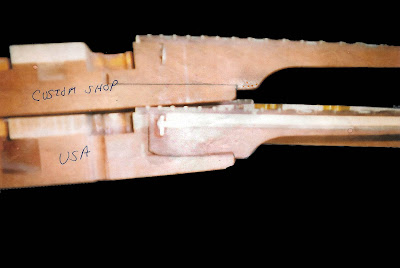
Neck_Joint_US_vs_Cust-Mod.jpg


all Gibson production Les Pauls use the short design (on the bottom). my problem isn't with the length of the tenon (*chuckle*), but the curved shape at the bottom (*chuckle*). it doesn't promote good contact and allows for too much variation of the neck angle. the top version is what comes on all Custom Shop (Historic, VOS, etc) Les Pauls. the only exception to either of these is the current Les Paul Standard. not the "Standard Traditional", that one uses the short tenon. the Les Paul Standard. Its tenon looks like this:

id-519321_2.jpg


so basically, if you're spending north of $2500 on a Standard or Custom Shop, the neck joint makes good contact. below that, and it could, but you'll never know. some people don't care. i figure if i'm spending that much, i should care.

so why is this applicable to Epiphone? well, if they're using the rocker joint on Gibsons, then what cost cutting measure have they employed with the import line?

The Joe B model has the same long neck tenon that the more spendy Gibsons have. so does the Slash model. but your standard Epi LP looks like this on the inside:
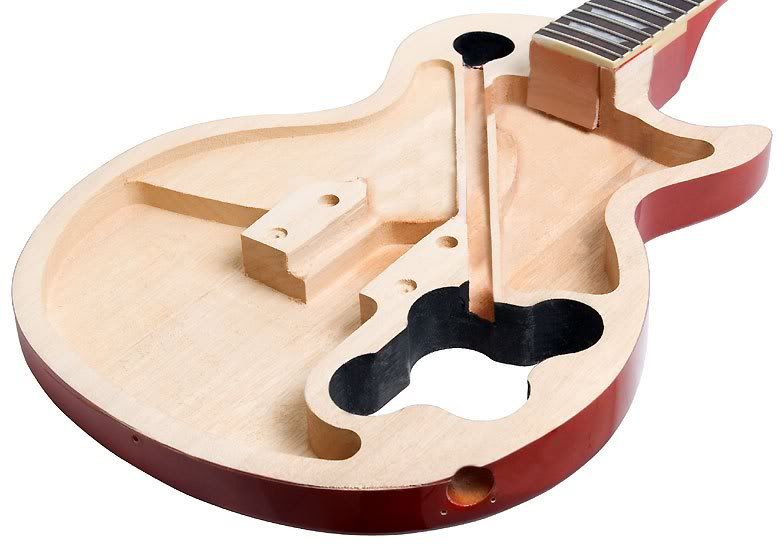
epiphone-les-paul-ultra-in.jpg


nevermind the routing in the pic. All production Gibsons have that except for the "Traditional" line, which looks like swiss cheese instead. what you're interested in here is the neck joint. the bottom is flat and there's a lot of contact there. some people complain of a gap between the tenon and the cutaway side of the body joint. that can look like this:

DSC_3151.jpg


but as you can see, the bottom is still flat and there's still a lot of contact. it's sloppy, but at least there's no rocking back and forth. also, the heel of the joint would prevent any movement.

so my thought is this. either get an Epi Les Paul Standard for around $500 or spend $2500+ on a Gibson Standard (not Traditional) or Custom Shop. at least based on the neck tenon.
 
I understand where you're coming from but I'm perfectly happy with my 2004 Les Paul Standard.

Why do they put the curve in the tenon anyway?
 
All I know is my 2009 LP Standard sounds great..and so does my friends '05. :shrug:

i don't think anybody is saying that the rocker joint can't produce a great sounding guitar. it's just an unnecessary cost cutting measure in today's CNC world. maybe it was necessary back in the 70s to account for slight differences in the body routing. but that's all gone now (along with the labor skilled enough to account for it).

also, your '09 Standard has the new joint.
 
meh...I purchased a 91 Standard off of a friend of mine and I could care less what neck joint or routing it has. I'm a fan of the 90's Gibson's for some reason and I'm sure they aren't the epitome of craftsmanship....so what. It plays nice and sounds good...that's all I need. If I was shopping for a new one I may be a bit more critical.
 
meh...I purchased a 91 Standard off of a friend of mine and I could care less what neck joint or routing it has. I'm a fan of the 90's Gibson's for some reason and I'm sure they aren't the epitome of craftsmanship....so what. It plays nice and sounds good...that's all I need. If I was shopping for a new one I may be a bit more critical.

how much less?
 
I think the new standard top mount neck tenon is a great idea that Gibson probably should have switched to long ago. I don't really care very much about neck tenons, but it is somewhat comforting to know my LP standard (a new model) has good contact surfaces with the neck/body.
 
I do see your point somewhat. The Hamer I bought a while back has a short tenon. I didn't know it until I pulled the neck pickup out after I got it. It wasn't on my mind at all when I purchased it. I plugged it into an amp and played it and I liked it. Now that guitar only cost me 500 instead of what, 2k, for a new Les Paul and they have similar tenons. I'm assuming component, material and labor costs factor into the prices as well. I've played both regular and historic Les Pauls and I can't tell the difference in regards to sound and playability between long and short tenons. The only difference i can notice is the weight of the guitar as well as the neck shape. I'm pretty sure that would not be a driving decision for me personally when it came to a purchase. If someone can tell the difference then they have one up on me.
 
I do see your point somewhat. The Hamer I bought a while back has a short tenon. I didn't know it until I pulled the neck pickup out after I got it. It wasn't on my mind at all when I purchased it. I plugged it into an amp and played it and I liked it. Now that guitar only cost me 500 instead of what, 2k, for a new Les Paul and they have similar tenons. I'm assuming component, material and labor costs factor into the prices as well. I've played both regular and historic Les Pauls and I can't tell the difference in regards to sound and playability between long and short tenons. The only difference i can notice is the weight of the guitar as well as the neck shape. I'm pretty sure that would not be a driving decision for me personally when it came to a purchase. If someone can tell the difference then they have one up on me.

tonally, nobody can tell the difference. it's more a difference that you'd be able to see at the bridge. stand two short tenon Les Pauls next to eachother and it's highly likely each will have a different neck angle. too much angle, and you could lose height on the mounting studs (*chuckle*) and never get rid of the fret buzz. not enough angle, and you'll always have high action; or you won't have enough break angle from the bridge to the tailpiece and the string will buzz there. so you remove a huge variable by eliminating the rocker joint. this makes for a more consistent guitar and one less thing to figure out in "getting a good one".
 
tonally, nobody can tell the difference. it's more a difference that you'd be able to see at the bridge. stand two short tenon Les Pauls next to eachother and it's highly likely each will have a different neck angle. too much angle, and you could lose height on the mounting studs (*chuckle*) and never get rid of the fret buzz. not enough angle, and you'll always have high action; or you won't have enough break angle from the bridge to the tailpiece and the string will buzz there. so you remove a huge variable by eliminating the rocker joint. this makes for a more consistent guitar and one less thing to figure out in "getting a good one".

Good stuff HIAR. That explains all the years of searching for a decent playable Les Paul. I now own two, but it took a long time to find them.
 
tonally, nobody can tell the difference. it's more a difference that you'd be able to see at the bridge. stand two short tenon Les Pauls next to eachother and it's highly likely each will have a different neck angle. too much angle, and you could lose height on the mounting studs (*chuckle*) and never get rid of the fret buzz. not enough angle, and you'll always have high action; or you won't have enough break angle from the bridge to the tailpiece and the string will buzz there. so you remove a huge variable by eliminating the rocker joint. this makes for a more consistent guitar and one less thing to figure out in "getting a good one".

Hmm....I do see your point on consitency. It would be rather annoying to play a wall full of Gibsons and each one be different. I have had that problem at Guitar Center but I just figured they don't maintain their stock very well since every guitar I've tried there, no matter the manufacturer, plays like shit off the wall. Maybe a setup would fix whatever issue they had or maybe it wouldn't. I'd never buy a Gibson at Guitar Center either so there's no point in me thinking too much when I'm there.

As long as I can try before I buy, I should be able to purchase guitars that feel and sound great no matter how they are constructed. I mean, there are some glaring ones out there that I'll always stay away from but I normally give any guitar a spin if it looks interesting. Plus shopping for guitars is supposed to be fun and I don't mind taking the time to find a good one.
 
Hmm....I do see your point on consitency. It would be rather annoying to play a wall full of Gibsons and each one be different. I have had that problem at Guitar Center but I just figured they don't maintain their stock very well since every guitar I've tried there, no matter the manufacturer, plays like shit off the wall. Maybe a setup would fix whatever issue they had or maybe it wouldn't. I'd never buy a Gibson at Guitar Center either so there's no point in me thinking too much when I'm there.

As long as I can try before I buy, I should be able to purchase guitars that feel and sound great no matter how they are constructed. I mean, there are some glaring ones out there that I'll always stay away from but I normally give any guitar a spin if it looks interesting. Plus shopping for guitars is supposed to be fun and I don't mind taking the time to find a good one.

i usually don't get to the neck angle when shopping for Gibsons. usually because when i look at the bridge, there isn't any travel left on at least one of the saddles. then there's no point in even picking it up to figure out the rest.

i find it no accident that the one guitar i own with a suspension bridge is a Ric. if you run out of room on that thing, you've got problems.
 
I understand where you're coming from but I'm perfectly happy with my 2004 Les Paul Standard.

Why do they put the curve in the tenon anyway?

The rocker style short tenon was designed to make setting the neck quicker and easier by providing a little wiggle room. Prior to this design, they would fit the neck and if the angle was off, it would require tweaking (IOW, labor time). With the rocker tenon, the neck angle is set before the glue is dry with a jig, IIRC. When it cures, the neck theoretically should be set at correct angle. But like previously mentioned, it's generally agreed that the tenon design isn't really indicative of a good LP or a bad LP, from a playing or tone perspective.
 
I want to sound like Duane Allman. Which type of tenon joint did he have?
In all the neck tenon designs the only real bond between the two pieces of wood is the glue that holds them together, and it's generally harder than the wood itself. I can understand trying to help someone get a good guitar, but if they can't afford a $2500.00 Les Paul, what's the point?
 
I want to sound like Duane Allman. Which type of tenon joint did he have?
In all the neck tenon designs the only real bond between the two pieces of wood is the glue that holds them together, and it's generally harder than the wood itself. I can understand trying to help someone get a good guitar, but if they can't afford a $2500.00 Les Paul, what's the point?

Duane died in 1971. there's no way he could have played a guitar with a rocker joint.

the point is that no matter how much you spend, you shouldn't get a piece of shit. knowing what to look for can only help in that endeavor.
 
Help!I'maRock! Thank you for putting up these pictures and your explanations. It's good to see it all together.

And uh, back in the sixties, if you had a 50's Les Paul, screwing in the neck was considered one way to finish the guitar.
Nowadays, it seems to be all about headstocks breaking, but necks went too, unless.

B Valley! I like to sound like Duane Allman too, one of the reasons I got a P.A.F. Humbucker on my guitar.
The biggest difference between the Les Pauls he liked, the ones that didn't sell at the time and were discontinued,
and the newer ones, was the difference in weight. A '64 Les Paul Standard could weigh twice as much.
You'd have to find a very light body and neck for that.
But if you're not looking that hard, trying to play the harmony lead solos by yourself should keep you busy.
"You're my blue skies, you're my lucky days", is nice for that.
 
Back
Top