Ask a (hack) luthier!

dougk

b00b
I'm not sure how many builders hang around on here, I'm sure plenty but I thought I'd throw this out there. I'm more of a guitar builder thank a luthier IMO but I'm happy to offer advice, insight or at the minimum, if I know someone else has a good answer, where to go. If I don't know the answer (probably most of the time LOL).

I'll kick it off. I posted this a couple years ago on facebook but this is how I slot nuts, quickly and right to the depths I want every time.

Tools you'll need:
5 dollar set of "tappet feeler gauges" available at any autoparts store.
Set of nut files (don't skimp, you'll get a life time of use out of them.
optional extra: files for shaping the nut
masking tape
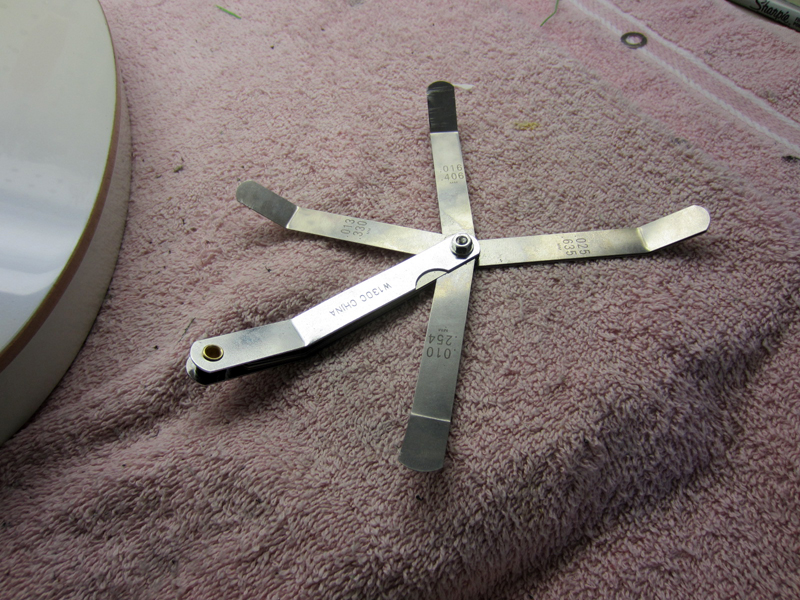
135481643.jpg

This is your feeler gauge set. They come in straight and angled, I like the angled. (Recently Stewmac started selling their version of this, which I'm sure is much easier to hold and more expensive. Auto store ones are fine).

They will typically have about a dozen to two dozen different thickness gauges. This set of .005 to .026 iirc
135481644.jpg

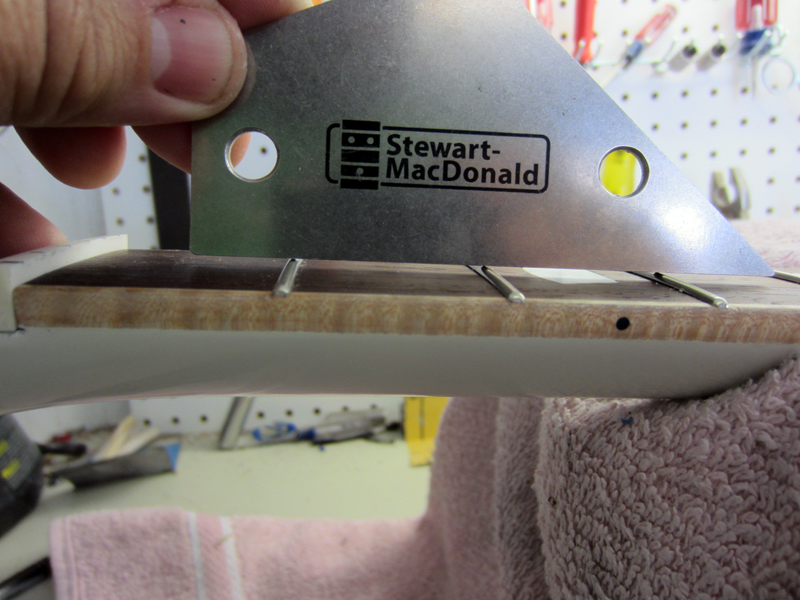
Next take a straight edge across the first couple frets
135481645.jpg

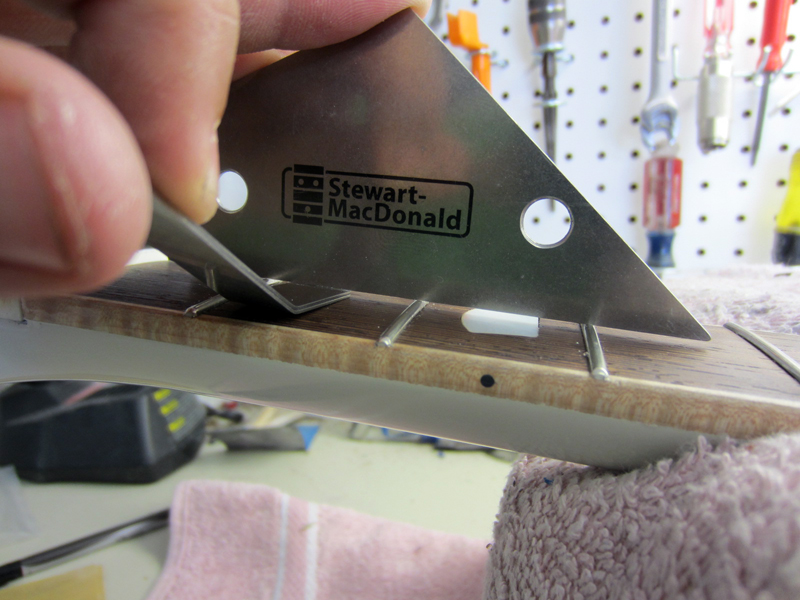
and stack up your feeler gauges till it just touches the straight edge to find your fret height.
135481654.jpg

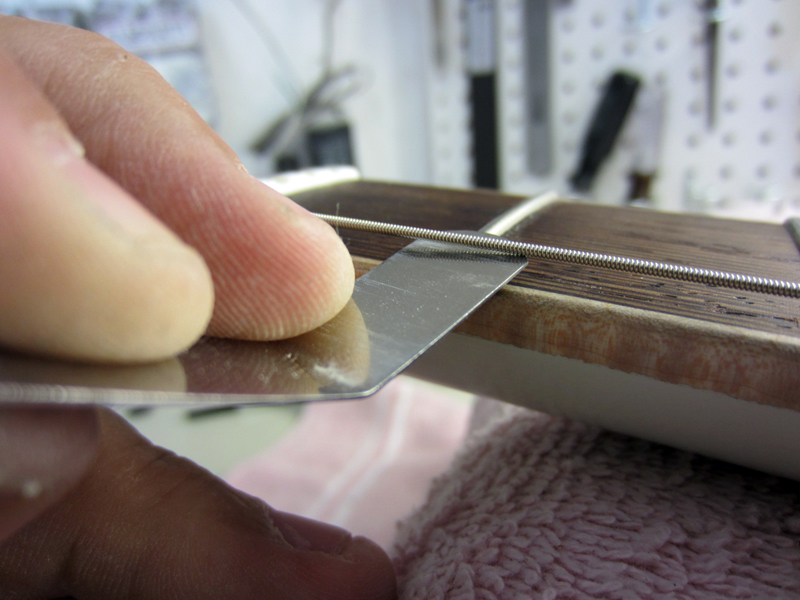
This picture is a little out of order and will come up again but what I recommend is, go around to your favorite playing guitars and measure the string height off the first fret. If you want, you can capo at the 12th fret and then again at the 5th fret if you play with very tall action / lots of relief. Stack the gauges again (if needed) till you just make contact with the string.

I set our guitars up with .016" off the first fret. This is plenty low but gives a fair amount of life in the nut (you can can take it down to .010 or less if you want but I find they will almost certainly buzz with changes in the neck, weather or frankly a dozen or so string changes). At the 12th fret I do .050-.055" height with .005" relief.

The key is here, to start putting numbers to actions you like instead of "this feels right" and "ohhh :holds fingers apart: bout this much". Once you can start writing down your favorite specs, it's easy to set up other guitars to match or be aware of how the weather is affecting your relief, setup ect.
135481646.jpg

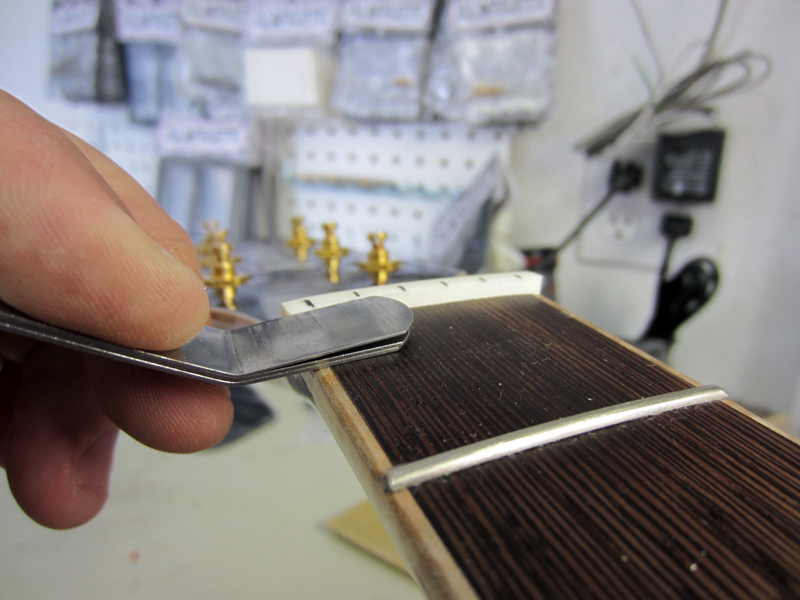
Now that you have a number to work towards, simply add your desired height to your fret height and you are set. In my case, our frets usually end up right about .050" in height after level and crown and I like .o16 so I stack .016, .025, .026 (based on what I have in my set).
135481648.jpg

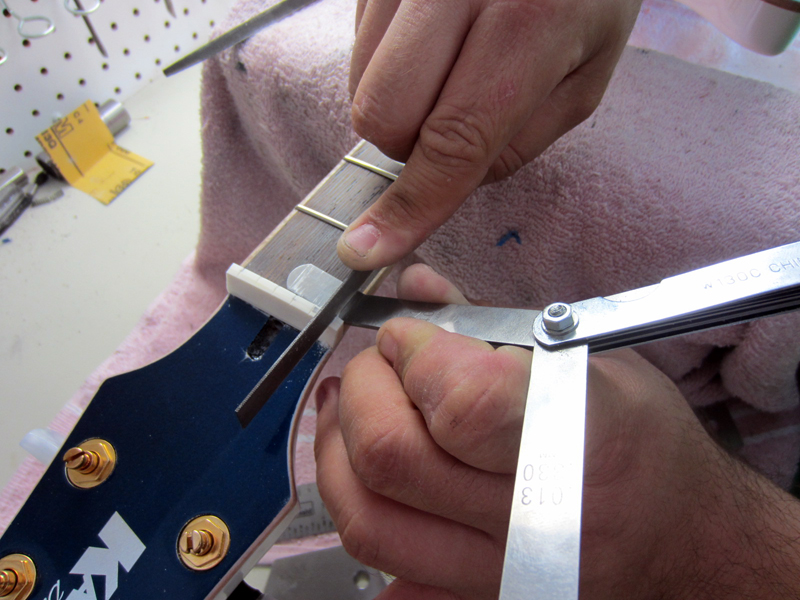
Now after marking your string spacing, file down till you just touch the feeler gauge. This will get you on the money almost every time. If you want, you can start conservative and check your work...

135481654.jpg

by stringing it up, and measure, verify or cut some more. Lets say you slotted everything till you touched the feeler gauge and when you measure you have .020 instead of .016". Just remove .004" from your gauge set and file some more.

Word of warning, verify capo'd around the 5th fret before you cut any deeper. If you have the bridge set very tall or relief set very large, you can get an artificially high reading at the first fret.
135481651.jpg


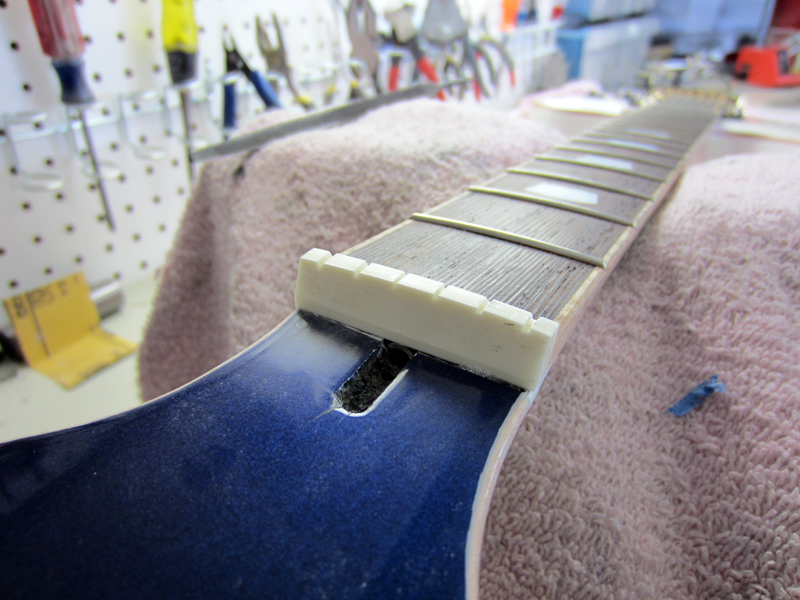
Work your way across and you're done! Then you can shape the top of the nut to your preference.

Super easy. Useful for not only new nuts but improving lower priced, poorer playing guitars. Most of the budget guitars really just need an extra 20 minutes attention at the nut to bring string height around, solve binding ect.

Hope this helps! I'll see what other things I can come up with for you guys.

edit: this is StewMac's new tool which is the same concept for 63 bucks: http://www.stewmac.com/shop/Tools/S...lot_Nut_Guard.html?actn=100101&xst=1&xsr=1811 Looks slick and I'm considering it just because I do this so often that I could probably justify the cost. It is a bit tricky to hang onto the feeler gauge set AND file but these files at a parts house are 5-10 bucks.
 
Hi Doug. Do you keep all six strings the same height off of the first fret? In slotting nuts, I've run the D G B and high E string near the same spec while running the A and E a touch higher. The amplitude of the open A and E seems to run higher than the rest of the strings and I'd like to avoid the open E string rattle. What do you think?
 
Doug, I'd be curious to learn if you ever made or plan to make an acoustic and what the challenges would be as opposed to an electric.

Thanks for sharing your knowledge with us.
 
Great information. Stewmac is a great one-stop-shop for proper tools for guitar work.

There's also some debate between those who like a really straight neck and who likes a little relief. I'm from the latter group where I like to keep the bridge close to the body, saddles with a little air underneath them (strat, tele, and PRS saddles) and a hair of relief so the action is low but not shredder low along the whole neck. I feel like necks with no relief end up having the action gradually higher down the neck because of the bridge height.
 
Cool thread Doug:thu:

One question; I noticed you marked the nut with a pencil to show where each slot should be cut. Is there a formula for the spacing, both from the side of the nut and between each string? I'm sure it would be easy if replacing an existing nut, but if you were starting from scratch (which I assume you are during a build) I would think you have a template.

Again, great thread idea and I hope you do this on a regular basis. Most of use do some work on guitars, but are afraid of certain aspects.
 
Wait a minute. Dougk? As in Doug Kauer? You are far from a hack. I love your work. Hopefully I'll be able to afford it one day. Welcome to the forum.
 
  • Like
Reactions: Tig
One question; I noticed you marked the nut with a pencil to show where each slot should be cut. Is there a formula for the spacing, both from the side of the nut and between each string?...

Stewmac makes a ruler for that!!!

Instead of equal spacing, there is a ruler for proportional spacing. Basically the spaces between the strings are equal and it takes into account the thickness of each string.

ts0028a.jpg


You can move up and down the ruler based on the nut width and find your string spacing.

ts0028k.jpg
 
Hi Doug. Do you keep all six strings the same height off of the first fret? In slotting nuts, I've run the D G B and high E string near the same spec while running the A and E a touch higher. The amplitude of the open A and E seems to run higher than the rest of the strings and I'd like to avoid the open E string rattle. What do you think?

You can do this, absolutely. I find .016" is generally high enough to ring most normal electric gauges (9-11's) with out issue. I used to do .016 for the wounds, .013" for the unwounds but found it was a finicky line with the unwounds to keep them from not buzzing at the first fret.

We'll come back to this later but there are three major variables in setting up a guitar, nut, bridge, relief. They all affect each other. I do what I call a middle of the road setup: the nut is as low as I can go (imo) with out being to sensitive to string gauge, relief or action preference. I myself tend to like .016" at the nut, .065" bass side 12th fret, .050" treble side. This feels tall to most people on the bass side. So the guitars I setup for sale are .016" / .055" even across all 6.

My biggest pet peeve is people who complain that the action is to high/to low at the bridge when they get a new guitar. That's like bitching that the last person who test drove the car you just bought left the seat in the wrong position for you. It's adjustable for a reason!! The nut end isn't so you have to play that one to work over a variety of relief and action preferences. (enough people on here have played mine to know they are setup pretty dang nice out of the box).

Doug, I'd be curious to learn if you ever made or plan to make an acoustic and what the challenges would be as opposed to an electric.

Thanks for sharing your knowledge with us.

Honestly Gary, I don't see it my future. For starters, I'm terrible at bending wood though I'd like to get better but the main reason is there are literally hundreds of way more talented acoustic builders 90 minutes from my shop as it is (santa rosa/san rafael, santa cruz, all norcal hubs for acoustic builders). I just don't feel like there's anything I could bring to that market better than anyone else.

Not that I think my electrics are better than everyone elses, far from it. However, they have features, aesthetics, woods and pickup choices all designed together in a system that really almost nobody else does quite the same way (especially Spanish Cedar, only a few of us are real flagwavers about it). If you want a Starliner or an Acadian or whatever I make ('cept for the Banshee) you can't find that specific shape and formula from anyone else.

If I built a D28 clone... well shit, you can find that from about a thousand other builders. :wink:

One day when I'm less busy (lol) I may do it for fun though.

Have you ever built a guitar with a graphite neck?

Nope, only graphite reinforcement. For the sound I prefer our guitars to have, I actually find the stiffer/harder the neck, the more I hate it. I want it stable, but I don't want it super hard/dense. (except for my Crusader and Acadian model, they are built to do an entirely different thing tonally).

Great information. Stewmac is a great one-stop-shop for proper tools for guitar work.

There's also some debate between those who like a really straight neck and who likes a little relief. I'm from the latter group where I like to keep the bridge close to the body, saddles with a little air underneath them (strat, tele, and PRS saddles) and a hair of relief so the action is low but not shredder low along the whole neck. I feel like necks with no relief end up having the action gradually higher down the neck because of the bridge height.

This relates exactly back to my earlier comments. That's why going around measuring your favorite guitars will really help start to give you a real understanding of what's going on. Sometimes "well X guitar just plays easier than Y guitar even though they are both Z" can be as simple as a couple hundredths of a tweak one way or another.

I have a friend who I play with. Every guitar of mine he plays "it's great but it would be better with more relief and higher action". Finally I just said "Dave, you only feel that way because you grew up playing pieces of SHIT that wouldn't play correctly any other way so shut up. I get it!" (in good humor ofcourse). It's all preference. Aint no right or wrong.

The reality is, I tend to like my setups like you described, relatively low with enough relief to let the strings ring clear. If I know someone wants super low, flat action, I'll add some fall away above the 12th fret in the leveling process. If someone likes tall action and tons of relief I'll do the fretwork flat as can be, then adjust the neck to suit. Otherwise I just split it right down the middle.

Cool thread Doug:thu:

One question; I noticed you marked the nut with a pencil to show where each slot should be cut. Is there a formula for the spacing, both from the side of the nut and between each string? I'm sure it would be easy if replacing an existing nut, but if you were starting from scratch (which I assume you are during a build) I would think you have a template.

Again, great thread idea and I hope you do this on a regular basis. Most of use do some work on guitars, but are afraid of certain aspects.

@baimun nailed it. I just use the SM ruler. I made this stupid little tool
154409869.jpg


That sets my distance from the edge of the neck/nut then I use the ruler to line up the inner 4. It's the ugliest tool I've ever made but it works! LOL

Can you do something about painting guitars?

This can cover volumes and even then, what may work for me specific may not work for you. If you have specific questions I can do my best but otherwise http://www.reranch.com/reranch/ is the best place on earth for hobbiest up to professional guitar painting info.

Wait a minute. Dougk? As in Doug Kauer? You are far from a hack. I love your work. Hopefully I'll be able to afford it one day. Welcome to the forum.

That's me! Thanks!
 
Last edited:
@dougk , you seem to be a huge fan of Spanish cedar. How come?

HUGE fan. It's all I build with for bodies (and in most situations necks).

For starters, it's about the closest thing out there to quality, old growth Honduran (trust me, what you have been getting for the last 10-20 years of "honduran mahogany" is terrible). It has the same thing tonally that old mahogany gets (I've played a few 50's LP's mostly 54-57 and one 58 briefly and scores of LP JR/specials from that era) which I love.

What I REALLY love is the weight. It's consistently the lightest mahogany you can find. Compared to African Mahogany (think PRS) it's substantially lighter much warmer in the mids with a vocal quality.

Now this doesn't work for everyone. It can make some pickups muddy (which is why ours our voiced specifically for my guitars) and can have a bit of mid-honk at the bridge for certain styles/amps/pickup combos. To me though, it's almost the best of mahogany and with a little of swamp ash's bite and snap thrown in. As someone who grew up playing strats my brain is probably hardwired to like a little more snap than most LP's.

Personally, I think it's almost impossible to make something that sounds bad with it, even my basses are made with Spanish Cedar for the body.

Where I REALLY swear by it is the neck. I'm in the absolute minority when it comes to necks among luithers. For my Starliner/Daylighter/Banshee line I absolutely, 100% hate hate hate HATE maple necks or super stiff, hard, dense necks in generally. When I build a neck, I'm interested in 2 things: tone and stability. Spanish Cedar necks, for us (again, there are many variables that go into the sound of a guitar, but based on my formula, wood choices and construction techniques. This doesn't apply for every guitar on earth) has this classic warmth and more importantly bloom that a good "les paul" style guitar should have. It's slightly compressed and slightly slower attack.

Maple necks in my guitars tends to go way too far towards: very quick attack, very quick decay (aka- sounds plinky or plunky to me). Flat or midscooped response. Very modern sounding. We've done a couple solid rosewood necks and I HATED those, even worse than maple. (in all fairness, the owners loved them- so again, this is just preference).

While the Spanish Cedar necks we built for the first few years are perfectly stable, about 4 years ago I started adding two maple splines that run under the fretboard and right out through the headstock face (hidden by the headstock veneer). I did this to improve stability over a wider range of conditions but mostly to add additional strength through that weaker transition point. I also do only an 11* headstock angle and I custom build our trussrods to remove the smallest amount of material that point (smaller than any other company I'm aware of on the planet). It helps.

The Crusader and Acadian either have maple necks only (crusader) or as an option (acadian). They have a 26.25" scale length and aren't designed to have that classic mahogany/humbucker tone. They are designed to have a much faster, flatter response. Even with that, I prefer softer maple varieties for the neck (big leaf or eastern) than harder (hardrock maple). I think the harder you get, the more midscooped and plinky it sounds. If you play shred metal, that's probably perfect. If you play super quick country picking then the softer maple variety is just fine too.

The beauty is, if you play mine and like mine tonally, then you know future endeavours together will probably be successful. If you don't, I appreciate giving them a chance, that's all I can ask for. The nice thing is, there are hundreds or thousands of other "formula's" out there to try too.

It also has a relatively low commercial demand so it's not being over harvested which appeases my inner hippie.

The biggest downsides of Spanish Cedar:

1. Because it's relatively low demand, it's also not highly imported. I have a supplier I work with who is pretty good but I have to buy a LOT and I still reject a fairly high amount.

2. It's not a large growing tree (or atleast what gets harvested). I actually haven't even had any boards wide enough to do 1 piece with in well over a year. Most of the time we end up doing two piece (I don't think I've ever done a three piece besides the Banshee) bodies but sometimes have to go with off center seams for the back. I'm going to choose a body / back blank based on tone, weight and quality of piece first, center seam is barely a consideration. If I think it's going to be the best sounding piece of wood to work with, I'm going to use it.
 
I'm just going on record as saying I love this forum and it's members, new and old, more and more as time goes on.
 
Back
Top